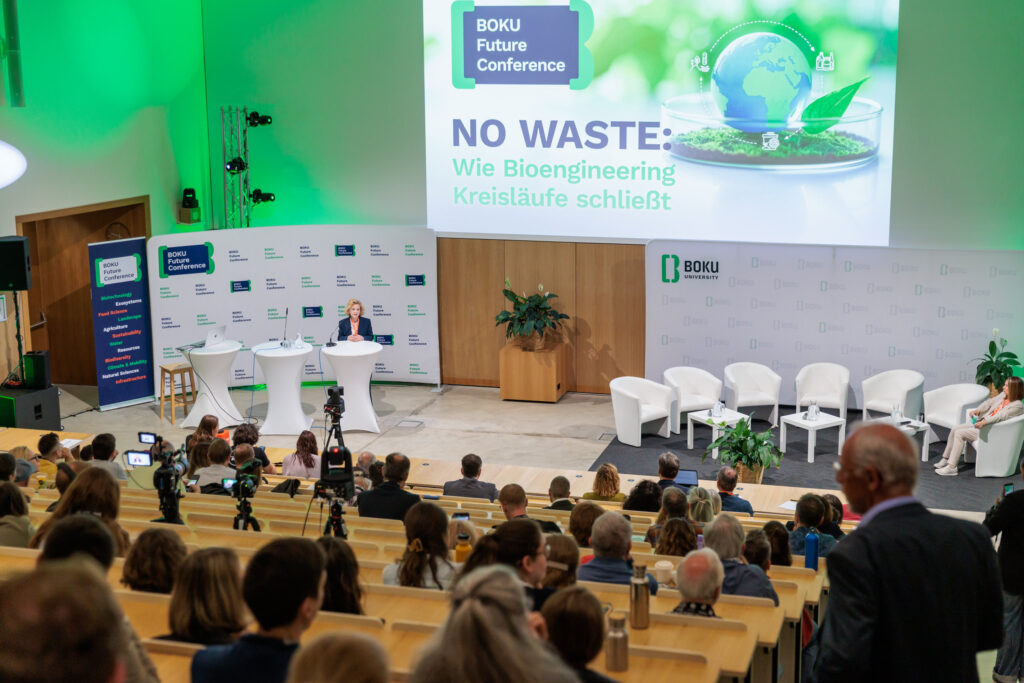
On 20 May 2026, the BOKU Future Conference brought together researchers, entrepreneurs, artists, students, and innovators to explore one central question: how can bioengineering help close material and energy loops for a more sustainable future?
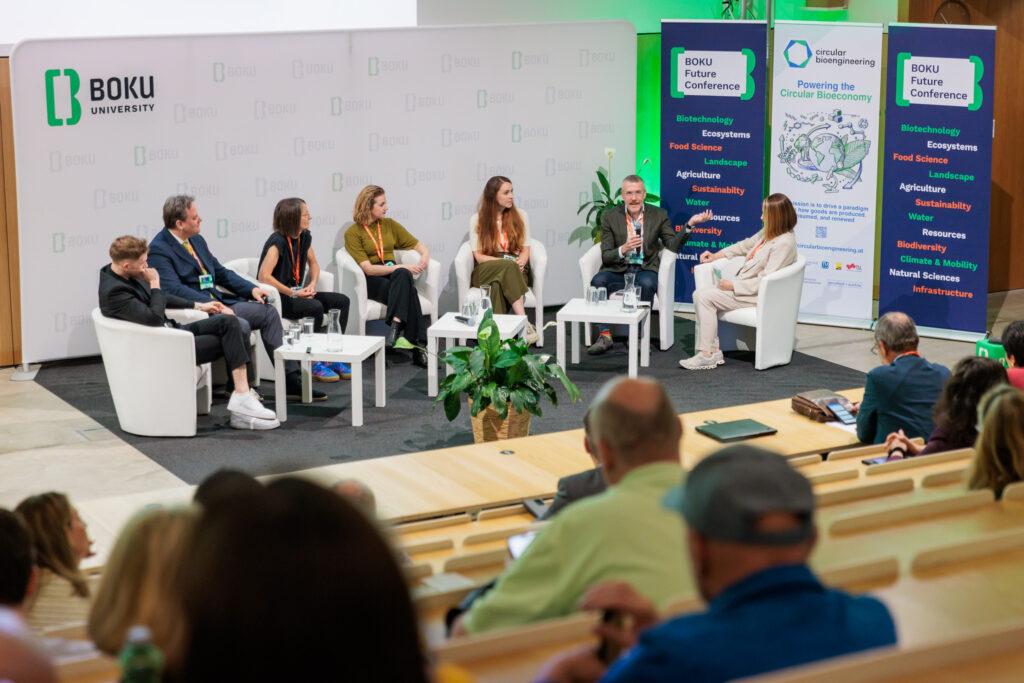
Opening note
The conference opened with welcoming remarks from Eva Schulev-Steindl, Rector of BOKU University, Josef Plank, Chair of the University Council, Lucia Logar, Chair of the ÖH BOKU, and Eva-Maria Holzleitner, Austrian Federal Minister for Women, Science and Research. Their contributions emphasized the importance of interdisciplinary collaboration, scientific innovation, and education in addressing global sustainability challenges.
The opening program also featured an inspiring keynote impulse by physician and science journalist Eckart von Hirschhausen, who highlighted the close connection between environmental sustainability, science communication, and societal transformation.
You can watch the recording of the opening, below:
Under the theme “NO WASTE: Wie Bioengineering Kreisläufe schließt”, the conference highlighted how circular approaches can transform the way we produce materials, chemicals, food, and energy. Throughout the day, speakers discussed the role of renewable resources, microorganisms as cell factories, and new technologies that enable climate-friendly bioprocesses and circular value chains.
Visualizing Circular Bioengineering
One of the conference highlights was Visual Talk by director of the cluster, Roland Ludwig, and chemist and designer, Johannes Richers, offering an engaging and accessible perspective on what circular bioengineering means and why it matters. The Visual Talk invited the audience to look beyond traditional scientific presentations and experience circular bioengineering through storytelling, design, and visual communication.
Together, Johannes Richers and Roland Ludwig explored how biological systems can inspire and enable circular solutions for some of today’s most pressing environmental challenges. Their talk demonstrated how interdisciplinary collaboration between science, design, and communication can make complex concepts tangible and relatable. Rather than presenting circularity as an abstract sustainability goal, the talk illustrated how bioengineering can actively close loops:
- transforming renewable raw materials into valuable products
- using microorganisms as highly efficient production systems
- reducing dependence on fossil-based resources
- creating bioprocesses that minimize waste and emissions.
The visual format encouraged audiences from diverse backgrounds to engage with scientific ideas in an intuitive and inspiring way, reflecting the conference’s broader ambition to connect research with society.
You can watch the visual talk below:
The conference program covered a wide range of topics related to circularity and sustainable innovation. Discussions addressed the future of circular economies, the opportunities and challenges of renewable raw materials, and the importance of science communication in making complex systems understandable.
Throughout the day, leading researchers from BOKU University and international institutions exchanged perspectives on how life sciences and biotechnology can contribute to a resilient and climate-conscious future.
For the Cluster of Excellence Circular Bioengineering, the event represented an important opportunity to showcase how cutting-edge research can contribute to real-world transformation. The cluster’s work focuses on developing sustainable biotechnological solutions that support circular resource use and help replace fossil-based processes with renewable alternatives.
Photo credits: © Christoph Gruber