Cluster of Excellence Circular Bioengineering: We're in!
On April 24, 2026, from 5:00 p.m. to 11:00 p.m., knowledge becomes an experience at the Long Night of Research. Through exhibitions, guided tours, hands-on stations, workshops, experiments, and other formats, visitors can embark on a journey through a wide variety of research disciplines and topics, discovering new and unexpected things along the way.
The Long Night of Research is Austria’s largest event dedicated to science, research, and innovation and is aimed at all age groups. This year, the Cluster of Excellence Circular Bioengineering will be showcasing its work at the event across several stations:
"What Is ‘Circular Bioengineering’?"
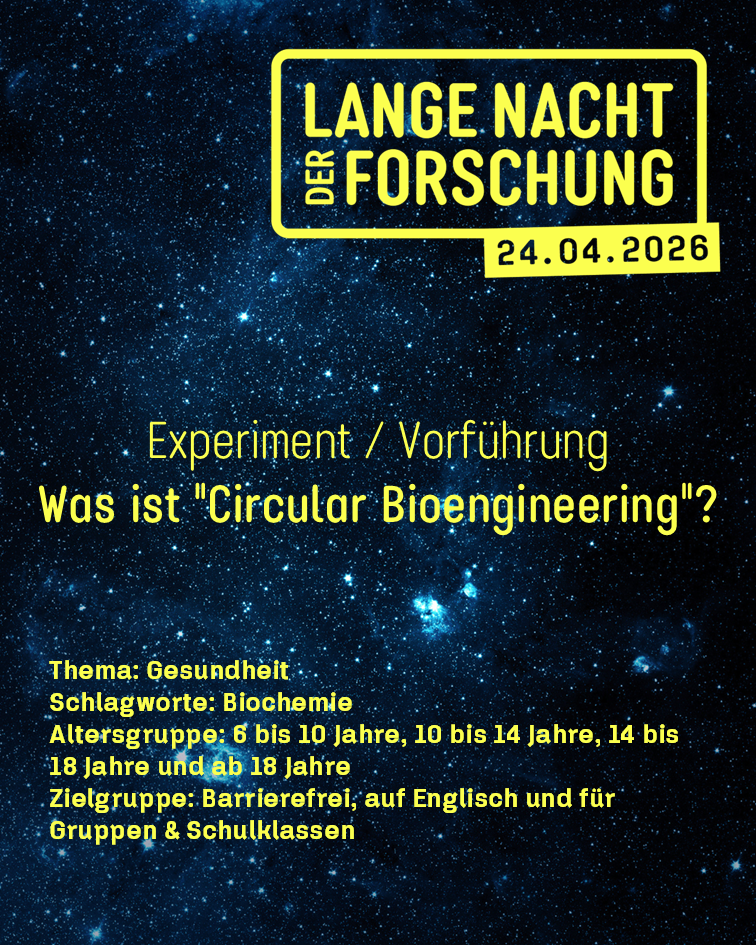
At the station titled “What Is ‘Circular Bioengineering’?”, enzymes will be presented as biocatalysts for converting renewable raw materials in a hands-on experiment. Together with visitors, cluster researcher Gaurav Patil will conduct practical exercises such as pipetting, handling electrodes, and taking simple measurements. Learn more here.
“Industrial Biotechnology: How Can Microorganisms Help Combat Climate Change?”
In the exhibition “Industrial Biotechnology: How Can Microorganisms Help Combat Climate Change?”, cluster researcher Simone Bachleitner demonstrates how microorganisms can be “trained” to convert harmful byproducts such as CO₂ and waste into useful chemicals. This can make a significant contribution to more sustainable production. Learn more here.
“Puzzle Cells from Nut Shells for New Sustainable Materials?”
At the station titled “Puzzle Cells from Nut Shells for New Sustainable Materials?”, cluster researcher Notburga Gierlinger demonstrates how nut shells, which are typically discarded and incinerated, can be effectively recycled. Walnut and pistachio shells serve as a vivid example: their cells interlock precisely like pieces of a 3D puzzle and can be reassembled into sustainable composite materials with improved mechanical properties. Learn more here.
“Do cells have ‘organs’?”
“Do cells have ‘organs’?” Researchers at BOKU, including cluster researcher Vincent Kaltenbach, are investigating this question by exploring the world of organelles. Organelles are to cells what organs are to the human body: specialized units with specific functions. The example of the endoplasmic reticulum illustrates which organelles exist and what functions they perform. Learn more here.
“What Do Proteins and Biomolecular Structures Look Like?”
The “What Do Proteins and Biomolecular Structures Look Like?” exhibit focuses on visualizing a wide variety of biomolecules—from proteins to substances found in the soil. Using 3D projectors, VR headsets, and large-format displays, invisible worlds come to life. Best of all, visitors can control the visualizations themselves, rotating, zooming in, and exploring the structures from every angle.
Come by and learn more about the cluster’s work. We look forward to seeing you! More information about the event can be found here.